
About the Program:
The PaintCare program provides a convenient and accessible option for recycling leftover paint across the State of Maryland, with drop-off locations available at participating retailers and local government facilities during regular business hours. These sites accept a wide range of architectural paint products—including latex and oil-based paints, primers, stains, sealers, and varnishes—provided they are in their original containers with their original manufacturer labels. While most locations accept up to five gallons per visit, individuals are encouraged to confirm site hours and accepted capacity in advance; larger quantities (100 gallons or more) qualify for a free pickup service through PaintCare.
The program is funded through a small fee with the purchase of new paint, allowing individuals, businesses, and institutions to recycle materials at no additional cost at the time of drop-off. Collected paint is managed using a "highest and best use” approach, prioritizing reuse and recycling—most commonly by processing latex paint into recycled-content products. With an estimated 350,000 gallons expected to be collected in Maryland during its first year, the program represents a significant step toward reducing waste and supporting more sustainable materials management practices statewide.
Important Facts:
- No additional cost at drop-off: PaintCare products can be dropped off at participating locations at no additional cost. The program is funded through a PaintCare fee applied when eligible paint products are purchased.
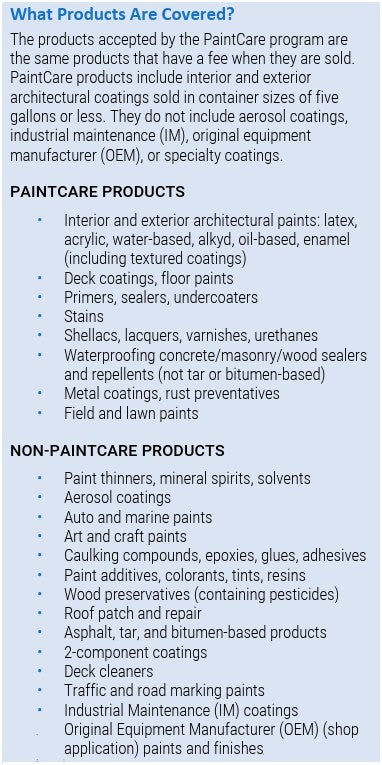
- Accepted paint products: PaintCare accepts most interior and exterior architectural paints, including latex, acrylic, water-based, alkyd, oil-based, and enamel paints. It also accepts deck coatings, floor paints, primers, sealers, undercoaters, stains, field and lawn paints, and certain metal coatings and rust preventatives.
- Other accepted coatings: Single-component shellacs, lacquers, varnishes, and urethanes are accepted, along with qualifying waterproofing sealers and repellents for concrete, masonry, and wood.
- Some paint-related products are not accepted: Paint thinners, mineral spirits, solvents, aerosol/spray paints, automotive and marine paints, art and craft paints, epoxies, adhesives, paint additives, two-component coatings, industrial maintenance coatings, traffic paints, and asphalt-, tar-, or bitumen-based products are not accepted through PaintCare. A full list of accepted and non-accepted products can be found here.
- Container requirements: Products must remain in their original containers with the manufacturer’s printed label intact and a secure lid. Containers that are leaking, empty, or missing the original manufacturer’s label are not accepted at participating drop-off sites.
- Oil-based and flammable paints are included: Eligible oil-based and other flammable architectural paints can be managed through PaintCare when they meet the program’s acceptance requirements.
- Large quantities: Free pickup may be available for locations with more than 100 gallons of eligible PaintCare products, subject to PaintCare requirements and restrictions.

Impact to the University of Maryland:
Historically, the Office of Environmental Affairs (OEA) manages over 10,000 pounds of unwanted latex paint each year, creating both disposal costs and operational demands. With the PaintCare program in place, departments have a more efficient option—allowing routine paint waste to be handled directly through local drop-off sites or large quantity pickup services.
By using this program, the University can significantly reduce disposal costs, streamline operations, and reduce waste while still ensuring proper environmental management. Departments are encouraged to take an active role by directing eligible paint waste to participating collection sites and sharing this information with staff.
It is important to note that some materials—such as thinners, solvents, aerosol paints, wood preservatives, and cleaners—are not accepted and must continue to be managed through OEA as hazardous waste. While this program will not eliminate all paint-related waste handling, it will substantially reduce the overall volume and support UMD’s broader waste minimization efforts.
More information can be found at PaintCare Maryland.